Some of the links in this story are affiliate links, which means we may earn a commission if you choose to purchase—helping us continue to share mindful, inspiring content.
Few people have taught more home cooks how to make dinner with confidence than J. Kenji López Alt.The James Beard Award winning chef, bestselling author, and food science enthusiast has spent years helping people cook smarter, stress less, and have a little more fun in the kitchen.
We caught up with Kenji to talk about the habits that make someone a better home cook, the kitchen tools he can't live without, and why making mistakes might actually be the secret ingredient to getting better in the kitchen.
In Conversation with Kenji
You’ve spent years teaching people how to cook better at home. What are the simple techniques you think instantly make someone a better home cook? More than any specific technique, I think the best way to become a better cook is to realize that cooking is a lifelong skill that you’ll continue to refine and get better at, while making plenty of mistakes along the way. I make mistakes at home, especially when I’m trying out a new idea, but the great thing about mistakes you make in the kitchen is that you get another chance to learn from that mistake, refine your process, and make it better the next time around. I think if you can find joy in that process, you’ve started down a successful path towards more joyful cooking.
If someone wants to become a better home cook this year, what are the first three things you’d recommend focusing on? First, try and go deep on a single subject that fascinates you. It could be a specific dish and all its variations, or a cuisine, or a culture. Just read, learn about the cuisine or the dish, then start cooking and get really good at that thing.
From there, you can start to draw connections between techniques or flavors you used in that dish and how they may be analogous to something in a new dish you’re trying to learn. Finding these connections and figuring out where skills or concepts can overlap goes a really long way to making me feel more comfortable and fluid in the kitchen.
Speaking of fluid in the kitchen, the last thing I’d recommend is to focus on your kitchen itself. Do you move through it in a way that feels natural? Do you find yourself getting frustrated by the placement of various tools? Do you find joy and pleasure using the tools that you own? Is your kitchen a calming or a frantic space?
I think really taking some time to make sure your kitchen feels comfortable and suited for your specific needs can make cooking so much more joyful and calming. If you make the kitchen into a place you want to be, you’ll naturally spend more time there.
What are the kitchen tools you genuinely think are worth owning and using regularly? Well aside from the obvious great knife and cutting board, I have a few things I can’t do without.
A bench scraper. Such a simple and useful tool. I use it for moving things around my cutting board, or for picking up a big pile of diced onions, or to clear a space to work, or to scrape my griddle clean, or to divide dough. I use OXO’s bench scraper, which also has a built-in ruler along the blade which has come in handy at times I least expected.
What spices or seasonings do you think every home cook should own? There’s no one-size-fits-all answer for this. The only ones that I’d say are essential are salt (I use kosher salt for cooking and various chunky sea salts for finishing), and maaaaaybe MSG. Sugar, if you count it. But for everything else, it really depends on what you’re into and what kind of cuisines you want to explore.
In my pantry, the most commonly used spices are cumin, various chilies, star anise, black and white pepper, sichuan peppercorns, fennel, sumac, sesame seeds, cinnamon, and nutmeg. Can you guess what kinds of foods I like to cook at home based on that list?
The most important thing is that unless you’re going to go through a batch within 6 months or so, it is virtually always better to buy whole spices and grind them just before use. It’s a night and day difference in flavor.
What are your best tips for making vegetables taste genuinely exciting at home? Get good vegetables! I know that it’s not always practical to shop locally at a farmstand or farmer’s market, but as much as you are able to, eat vegetables that are seasonal and local to you. Part of it is that they’ll simply taste better. But I also find that by cooking that way, we really mark the seasons and have the next thing to look forward to. I love that I’d rather eat incredible asparagus for two months of the year than mediocre asparagus year-round.
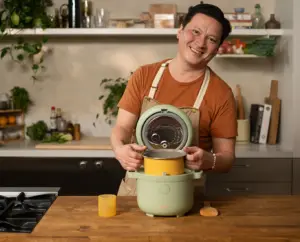
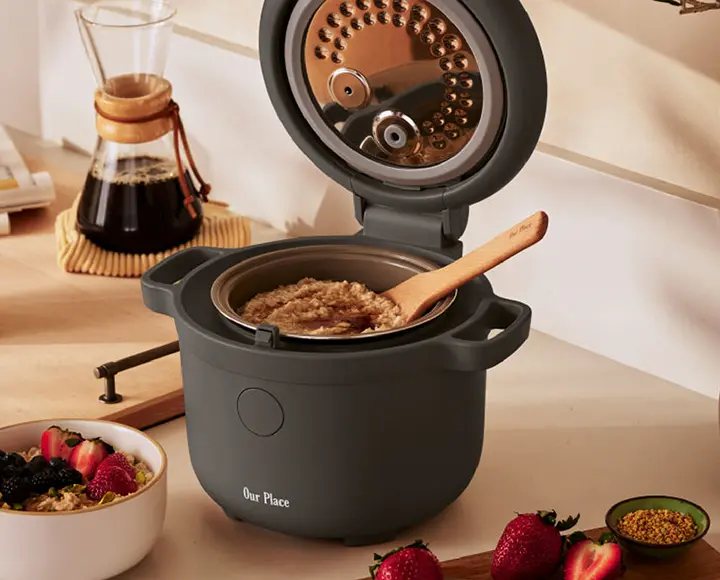
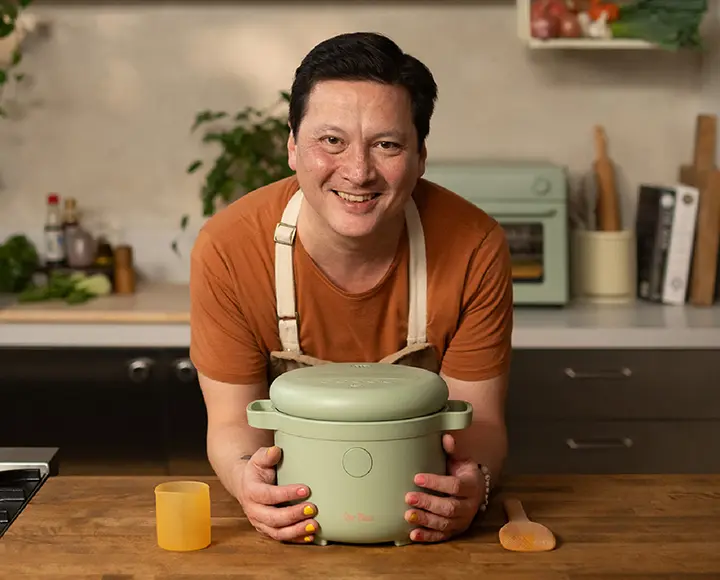
You recently collaborated with Our Place on a collection and designed their rice cooker. You’ve described this as the “grain cooker” you always wanted but couldn’t find. What specifically felt missing from most rice cookers on the market? It’s not so much that there was anything missing from other cookers, but what I really wanted was just the right balance of all the features I look for in a grain cooker, with an aesthetic that fits my kitchen. Having a fuzzy logic chip that dynamically adjusts cooking temperature results in perfectly cooked rice every time. I wanted a cooker that has tactile buttons and a simple interface. I wanted a cooker that was exactly the right size for my family (and we did the market research to find that it’s the right size for most families). I wanted a cooker that could keep my rice (and other foods) safely warm for a full day so it’s hot and ready when we’re ready to eat. I wanted a rice cooker that is easy to clean with no forever chemicals. I also wanted something aesthetically pleasing. I spend a lot of time in my kitchen, and I like it to look nice while I work.
SHOP THE OUR PLACE RICE COOKER HERE
For a lot of Asian families, rice cookers have always just been part of everyday life, while many American households are only now starting to embrace them more. Why do you think people are finally catching on? Once you get in the habit of using a rice cooker and start noticing its convenience, it’s just a natural tool for anyone who regularly cooks rice or grains. I’m sure a lot of rice’s current popularity has to do with better understanding of Celiac and gluten intolerances. It only makes sense that as more folks eat rice at home, more folks will want a rice cooker.
You prioritized a ceramic nonstick inner pot made without PFAS and other forever chemicals. Why do you think it’s important for people to pay closer attention to the materials their food comes into contact with every day? People think a lot about ingredients, but cookware is part of the cooking environment too. I’m not interested in fearmongering, but if we can make products that perform well while avoiding materials people have concerns about, that feels like the right direction to head. Good cooking tools should inspire confidence and be pleasant to use every day.
You included fuzzy logic technology in the cooker, which sounds very technical, but what does that actually change for someone using it at home? Fuzzy logic basically lets the cooker behave more like a good cook than a simple on/off machine. Instead of blasting heat until the water is gone, it continuously adjusts temperature throughout the cooking process. That means more evenly cooked rice, better texture, and more consistency with no extra effort from the user.
What are some of your favorite things to make in the Our Place rice cooker besides rice? I recently made a caramel apple bread pudding that was excellent. I cooked diced apples with butter, brown sugar, and a few spices directly in the cooker until they were lightly caramelized, then topped them with stale croissant chunks soaked in a rich custard. I cooked the whole thing for 30 minutes, then let it stay warm until dinnertime. It was the most tender bread pudding I’d ever made. SHOP THE OUR PLACE RICE COOKER HERE
What’s one cooking shortcut you fully support and use yourself all the time? Ordering in an emergency pizza.
What’s your personal definition of “good” home cooking now? Good home cooking is cooking that fits into your real life and brings people joy. Sometimes that’s an elaborate weekend project, and sometimes it’s rice, eggs, and leftovers eaten at the kitchen counter. If it nourishes people and makes your life and their lives better, it counts.
The post How to Cook Better at Home, According to James Beard Winning Chef J. Kenji López-Alt appeared first on The Chalkboard Mag.
from The Chalkboard Mag https://ift.tt/d2EoYTr
via IFTTT

No comments:
Post a Comment