You know the moment. You are talking through something small, a dinner plan, a work deadline, an offhand comment that landed sideways, and then somehow your voice has gone tight, your ears are hot, and the original topic has quietly left the room. Twenty minutes later it is over, nobody really won, and you are lying awake rewriting your half of it like a director who hated the first cut.
If you have been following along, you know this is our favorite kind of read, the one that quietly rewires how a regular day feels. We learned to stop carrying everyone else's expectations from The Let Them Theory by Mel Robbins, and we rethought our whole relationship with rest thanks to Why We Sleep by Matthew Walker. This one belongs right on that shelf, except instead of your inner life, it goes to work on your out-loud one.
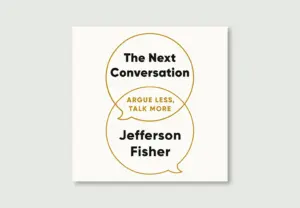
Enter Jefferson Fisher. He is a Texas trial lawyer who became an unlikely internet favorite by filming short, almost startlingly kind videos from the front seat of his truck, teaching regular people how to survive everyday arguments without losing themselves in them. His book, "The Next Conversation: Argue Less, Talk More," takes that same gentle, no-nonsense energy and turns it into something you can actually use on a Tuesday. And his whole philosophy rests on one quietly radical idea: winning was never the point. The point is to stay connected enough that the next conversation can even happen.
Here are the five takeaways from The Next Conversation that felt most useful.
+ The pause is the whole game
Fisher's most repeated piece of advice is also the one we are all most likely to skip, probably because it sounds too easy to count. Before you respond to something that stings, breathe. He calls it a conversational breath, an inhale and then a long, slow exhale, and the entire job of that breath is to cut off your stress response before it grabs the wheel.
We will be honest, the first time we read this we thought, that is it? That is the big secret? But here is the thing. That tiny gap is the whole difference between answering from your values and answering from your nervous system. As Fisher puts it, the fastest way to lose your peace of mind is to give someone a piece of yours. The pause is how you hang onto it.
The part we love most: it asks absolutely nothing of the other person. You do not need them to be calmer or kinder or more reasonable than they are being. You just need one breath before you open your mouth. That is a deal we can make.
+ Stop trying to win, start trying to understand
Here is the reframe that genuinely loosened something in our chest. A conversation is not a contest. Fisher points out that winning an argument almost always costs you trust, respect, and connection, which, when you say it out loud, is a wildly bad trade. Think about the last time you "won" a fight at home. Did you feel like a champion, or did you feel a little sick?
His alternative is to get curious instead of defensive. When someone reacts way bigger than the moment seems to warrant, that is your tell. There is a hidden conversation running inside their head that you were never invited to, and what you are seeing is just the tip of an iceberg you cannot fully map. Trading "how do I make my point" for "what might they be carrying right now" changes the entire temperature of the room. It also, conveniently, lowers your own.
+ Your words are quietly running the show
Fisher is a lawyer, so he listens to language the way the rest of us watch the sky for rain. And one of his sharpest catches is how much we shrink ourselves with little hedging words before we have said anything that matters.
"Just." "Sort of." "Sorry to bother you." We toss these in to seem softer and gentler, and instead they make us smaller. His fixes are refreshingly do-it-today concrete. Drop the "just." Swap reflexive apologies for gratitude, so "sorry I'm late" becomes "thank you for waiting," which, notice, hands the warmth to them instead of the guilt to you. Own your actions in plain words, so "please see attached" becomes "I'm attaching the contract." Tiny edits. Genuinely surprising shift in how you come across, and even more so in how you feel saying them.
He also names a habit we are all a little guilty of: overexplaining. His line on it has been living in our head rent free. The more words it takes to tell the truth, the more it starts to sound like a lie. Say the thing. Then, and this is the hard part, stop talking.
+ Frame the conversation before you have it
This one felt like being handed a tool we did not know existed. Fisher's theory is that hard conversations tend to combust because we drop people straight into them with no warning and no map. So he gives you one. It is a three part setup he frames as a kind of conversational contract: name the topic, say what you are hoping to get out of it, and ask if now is even a good time.
Written down it sounds a touch formal. Out loud it is just, "I'd love to talk through how we split the holidays this year. I'm hoping we land somewhere that feels fair to both of us. Is now an okay time?" That sliver of structure does something almost sneaky. It keeps the other person from feeling ambushed, and a person who does not feel ambushed shows up softer, more open, more willing to actually meet you. You are opening a door instead of kicking one in.
+ Direct and kind are not opposites
So many of us are quietly convinced that being direct means being harsh, so we hedge and cushion and bury the point until nobody, including us, knows what we actually need. Fisher calls this out, gently, the way he calls out everything. Speaking directly does not mean you lack empathy. It means you respect the other person, and yourself, enough to say what you need without flinching.
His playbook for the truly difficult people might be worth the cover price on its own. For the backhanded little comment, a calm "was that meant to be condescending?" hands the moment right back to its owner. For the person bulldozing you, you can honor the feeling without surrendering the facts: "that does sound frustrating" lets the air out of the balloon without giving up your ground. And underneath all of it runs the same north star. Make this conversation safe enough that the next one can still happen.
The post 5 Things We Learned From “The Next Conversation” by Jefferson Fisher appeared first on The Chalkboard Mag.
from The Chalkboard Mag https://ift.tt/oOVLIBh
via IFTTT










![Oura Ring 5 smart ring in titanium [finish]](https://thechalkboardmag.com/wp-content/uploads/2026/06/image8.webp)