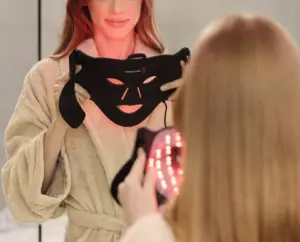
Red light masks are everywhere right now. Scroll for five minutes and you’ll see someone glowing under LEDs. Prices range from one hundred dollars to several hundred. Some promise collagen support. Others promise acne relief. A few promise both. And now, some even offer multiple colors of light, each claiming to target something different.
With so many options, price points, and promises, how are you actually supposed to know what works and what’s just clever marketing?
Last year, we decided to put the BON CHARGE Red Light Face Mask to a proper long term test. I used it consistently for a full year, just working it into my regular routine. At one appointment, my Botox injector looked at my skin and asked if I’d been doing anything differently. I actually hadn’t changed anything in my routine. The only new variable was the mask. You can read the breakdown of the experience here.
Personal experience is compelling, but it is not clinical validation. To go deeper, we asked Dr Shabana, a Physician in Integrative and Aesthetic Medicine and Clinical Dermatology Lecturer, what separates evidence-aligned devices from clever marketing.
Here’s what matters.
What Red Light Therapy Is Actually Doing Beneath the Surface
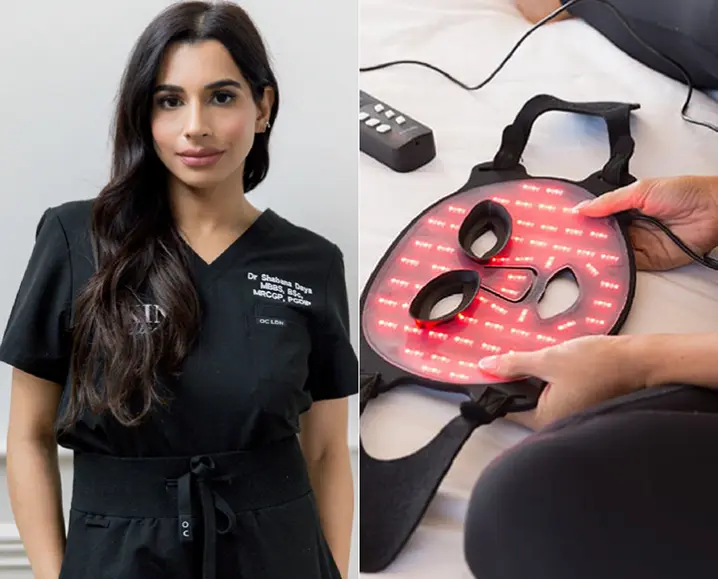
Red light therapy, also known as photobiomodulation, works by delivering specific wavelengths of light that influence cellular energy production.
Dr Shabana explains that as a physician, she focuses on whether a device uses clinically studied, biologically active wavelengths supported by peer reviewed data.
Her two non-negotiables are a red light wavelength at 630 nm and near infrared at around 850 nm. The 630 nm wavelength sits in the well studied range for superficial dermal penetration. Research shows red light in this range can stimulate mitochondrial activity via cytochrome c oxidase, support fibroblast function, and promote skin elasticity.
Near infrared at around 850 nm penetrates more deeply and may support dermal remodeling and recovery by influencing cellular energy production at greater depth. In other words, red light is not just glow. It is cellular signaling. But only if the parameters are correct.
The BON CHARGE Red Light Face Mask uses these clinically referenced wavelengths, delivering both 630 nm red light and 850 nm near infrared in a flexible silicone mask designed for consistent at home use. You can explore the device here and use code TCM15 for 15% off.
What a Physician Actually Looks For in a Red Light Face Mask
This is where hype gets filtered out.
According to Dr Shabana, wavelength is only the starting point. Yes, 630 nm red light and 850 nm near infrared are essential. But if the device does not deliver enough energy to the skin, those numbers alone mean very little.
She also considers whether the mask delivers enough power to the skin to reach the therapeutic range used in clinical studies. If the output is too low, the light may look impressive, but it won’t create meaningful biological change.
Engineering matters just as much as biology. Uniform LED distribution ensures the entire face receives consistent exposure rather than uneven pockets of light. Minimal excess heat improves comfort and safety. Consistent skin contact determines whether the energy is delivered effectively.
Design plays a practical role too. A flexible, medical grade silicone mask that contours closely to the face helps maintain even exposure and consistent energy delivery across treatment areas. If the mask lifts or gaps, you lose efficiency.
Transparency is another key factor. Credible brands publish wavelength specifications, irradiance levels, and recommended session timing so users understand dosing. Vague claims without clear numbers are usually a red flag.
When you apply that checklist to the BON CHARGE Red Light Face Mask, it aligns with the parameters she considers evidence based. It delivers the clinically referenced 630 nm and 850 nm wavelengths, is engineered for even coverage, and is designed for consistent, hands free use.
In fact, Dr Shabana believed in the brand’s approach enough to join the BON CHARGE Scientific Advisory Board. For her, that decision came down to alignment. The specifications, power levels, and overall design met the standards she expects in clinical practice.
And in the world of at home devices, that level of scrutiny matters.
Who Actually Benefits Most From Red Light Therapy at Home
Red light therapy is not designed to replace surgery or dramatic in clinic procedures.
Where Dr Shabana sees the most meaningful results is in patients with mild to moderate concerns that respond to cumulative, low level stimulation rather than aggressive correction.
This includes early fine lines, gradual collagen loss, mild laxity, and skin that looks a little more tired than it used to. In these cases, consistent red light use can support fibroblast activity and gradual improvements in tone, elasticity, and overall skin texture. It is not about dramatic change. It is about structural support over time.
This is exactly where at home devices like the BON CHARGE Red Light Face Mask can play a role. When a mask delivers clinically studied wavelengths such as 630 nm red light and 850 nm near infrared, and is used consistently several times per week, it can provide the type of repeated low level stimulation that research suggests supports collagen signaling and cellular repair.
Red light mask can also play a supportive role after in clinic treatments such as microneedling, laser procedures, and chemical peels. The near infrared component may help calm irritation and support tissue repair during recovery.
The common thread in all of these cases is patience and consistency. This is a long game tool for people who want steady, non invasive skin support rather than reactive, high intensity interventions.
So Is It Hype or Is It Biology
If you are expecting dramatic transformation in two weeks, you will likely be disappointed.
If you understand that red light therapy supports mitochondrial function, collagen signaling, and structural skin resilience over time, then it is not hype. It is applied photobiology.
For me, it was simple. I used it consistently, and someone who sees my face up close on a regular basis noticed a difference. When Dr Shabana walked through the science behind the wavelengths, power levels, and design, it connected the dots. What I was seeing in the mirror actually lined up with how the technology is meant to work.
In a market flooded with glowing masks at wildly different price points, the smartest move is not chasing the cheapest option. It is choosing a device that aligns with published parameters, delivers meaningful energy to the skin, and is designed well enough that you will actually use it.
That is where the BON CHARGE Red Light Face Mask stands out. It meets the clinical criteria she looks for, aligns with evidence based wavelength standards, and is built for consistent, long term use.
In other words, what we noticed in the mirror makes sense on paper and that is when a trend starts to look a lot more like a smart investment.
Explore the BON CHARGE Red Light Face Mask and use code TCM15 for 15% off. SHOP HERE.
All material on The Chalkboard Mag is provided for educational purposes only. Always seek the advice of your physician or other qualified healthcare provider for any questions you have regarding a medical condition, and before undertaking any diet, exercise or other health-related programs. This story is brought to you in partnership with BON CHARGE. From time to time, TCM editors choose to partner with brands we believe in to bring our readers special offers.
The post Is Red Light Mask Just Hype or Does It Actually Work? A Doctor Weighs In appeared first on The Chalkboard Mag.
from The Chalkboard Mag https://ift.tt/SNcyoP8
via IFTTT

No comments:
Post a Comment