Thursday, March 9, 2023

Should Daylight Savings Be Cancelled? Here’s What It Means For Your Health

Daylight Savings Be Cancelled 2023 change Loftie lamp

we're bracing ourselves for Daylight Savings on Sunday, March 12 -- meaning we'll lose an hour of health-inducing sleep and disrupt the sleep hygiene so many of us manage meticulously these days. But could it be the last time we have to perform the tiring chore? It's possible that the twice yearly adjustment is coming to an end.

Last year, The U.S. Senate passed the Sunshine Protection Act that would make daylight saving time permanent starting in late 2023. The bill's sponsors are waiting to receive final input from stakeholders like the airline and broadcasting industries before the change could become permanent come November. Our fingers are crossed.

Should Daylight Savings Be Cancelled?

According to a study by the Sleep Foundation, daylight savings can lead to increased heart problems, insomnia, mood disorders and even motor vehicle accidents. Many of us experience the time change as sleep disruption, darker mornings, and an overall kick to our emotional health.

Circadian rhythms are naturally occurring 24-hour cycles that regulate our body’s internal clock. Highly sensitive to light, these rhythms dictate how our body responds to the environment and can impact our productivity, sleep schedules and more.

According to Reuters, the House Energy and Commerce committee held a hearing in which Vanderbilt Sleep Division director, Beth Malow compared daylight savings to "living in the wrong time zone for almost eight months out of the year."

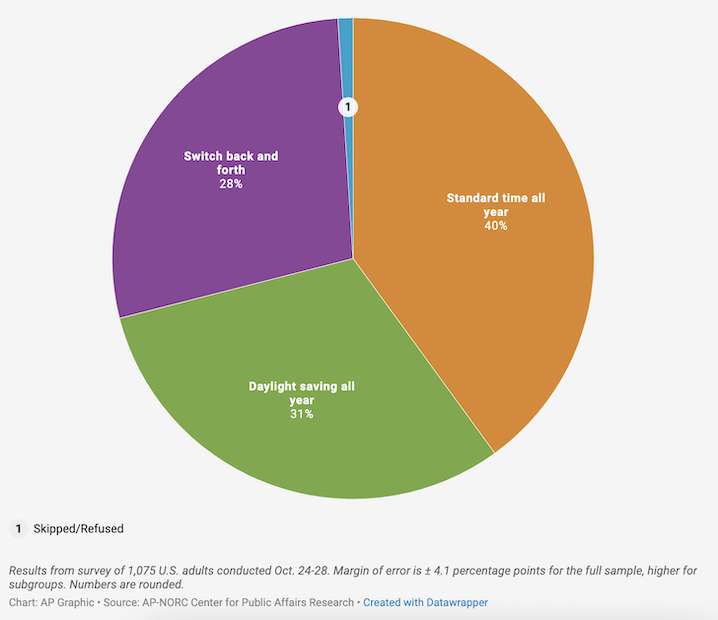
According to a 2019 AP-NORC Center poll, 70% of Americans agree that swapping times twice a year should come to an end. 
time change poll 2023

For this week, sleep disruption is still on and the Sleep Foundation recommends these simple tips to help you cope:

Practice Good Sleep Hygiene: Refrain from consuming alcohol before bed. Reduce heavy dinners and snacks before bedtime.

Establish a Consistent Sleep Routine:  Make sure you get at least seven hours of sleep each night before and after transitioning to or from DST.

Gradually Alter Your Bedtime: Two to three days before the change.

Spend Time Outdoors: Since natural light is a driving force behind our circadian rhythms, exposure to sunlight can alleviate feelings of tiredness during the day that often accompany time changes.

Nap in Moderation: People who experience sleep debt as a result of DST may find some relief by taking short naps during the day. These naps should never exceed 20 minutes in length; otherwise, you may wake up feeling groggy.

Don’t Consume Caffeine Too Close to Bedtime: Studies have found caffeine consumed within six hours of bedtime.

How do you feel about the possible change? Perhaps this will be one more cultural experience we can share with our future grandchildren as funny historical anecdote, instead of actual school day sleep disruption and dark walks to school.

The post Should Daylight Savings Be Cancelled? Here’s What It Means For Your Health appeared first on The Chalkboard.


from The Chalkboard https://ift.tt/ihQBYDn
via IFTTT

Intermittent Fasting for Women: How To Fast For Your Cycle

beeya women founders

The benefits of fasting are well-documented and range far and wide—fat loss, disease prevention, reduced inflammation, less brain fog, and more energy—just to name a few. But what about the effects of fasting on women and their unique cycles, specifically? We talked to the women behind Beeya Wellness for a refresh on the topic...

Intermittent Fasting 101

The term intermittent fasting encompasses several strategies that essentially equate to eating less or less often. One key benefit to fasting is that it activates autophagy, our body’s way of clearing out damaged cells to prevent disease. Studies show that even cases of more severe illnesses have responded well to fasting. While this practice may seem like a miracle cure or an easy approach for anyone to add to their wellness routine, one thing is clear: fasting for men is not the same as fasting for women.

Instead of mindlessly skipping meals (a big problem if you have blood sugar imbalances), intermittent fasting involves intentionally shortening the window of time in which you eat to allow your body to rest and digest during your fasting hours. In some cases, you’re actually limiting the amount of calories you eat. Here’s a quick cheat sheet on a few popular forms of fasting:

Time restricted eating | Eating all calories within a specific window, for example, only having your meals within 12, 8, 6, or 4 hours during the day.

5:2 method | Eating 500 calories 2x a week, and eating normally the rest of the week.

24 hour fasting | Fasting for an entire day, 1-2 times a week.

Alternate-day fasting | This more extreme version of fasting means fasting every other day.

If you have hormonal imbalances, you may be wondering if intermittent fasting is actually safe for your body. The benefits of intermittent fasting can include weight loss, increased energy, gut health, and mental clarity. Which of course you want! However, its broad definition and varying extremes means that not all forms of intermittent fasting are safe for all people, and women with hormonal imbalances in particular have special considerations to take into account when it comes to this lifestyle change.

For those with thyroid conditions, blood sugar imbalances, high cortisol, low cortisol, some cases of infertility, insomnia, and more, chronic undereating can wreak havoc. And, when it comes to weight loss, many women notice that calorie restriction starts as a simple way to lose weight and it quickly turns into the body storing fat in the face of famine.

Fasting For Women In Their Reproductive Years

Experts like Dr. Amy Shah recommend circadian fasting for your cycle. This means you can change your fasting window throughout the month to support your hormones while also eating in alignment with the sun. Here’s how to do it:

Menstrual Phase: Depending on the person, this could be a good time to experiment with your fasting window. Consider a 13 to 14-hour fasting window. For example, you might eat your first meal of the day around 9 am and your last meal before 7 pm.

Follicular Phase: If you’re thinking about more “extreme” versions of fasting, this is the time! Consider a 14 or 16-hour fasting window.

Ovulatory Phase: Depending on your goals, you may want to shorten your fasting window, especially if you want to get pregnant. Dr. Mindy Pelz explains that your body needs glucose and insulin during this stage. Additionally, fasting lowers levels of progesterone.

Luteal Phase: This is when fasting becomes the hardest. Your hunger and need for calories are likely to increase in this phase. Try a 12-hour fasting window. For example, eat all your calories between 7 am and 7 pm.

3 Rules To Live By When Incorporating Intermittent Fasting

01 | What you eat is as important as when you eat. Skipping breakfast only to gorge on snacks or carb-heavy meals defeats the purpose of fasting and can lead to significant cravings. Instead, focus on getting a balance of protein, fat and fiber with each of your meals. We love adding beeya seeds to our meals to get a healthy balance of macros.

02 | Instead of skipping breakfast, try going light on dinner. Evidence shows that eating heavier meals earlier in the day and lighter meals at night can support our fasting efforts, sleep, weight loss, and more.

03 | If you’re underweight, under-muscled, or struggling with major hormonal imbalances, stick to the 12-hour fasting window for now. The 12-hour window is one that pretty much everyone can follow.

At the end of the day, there is no one-size-fits-all approach to health, so listen to your body as you make adjustments and changes. It may help to keep a journal to record your symptoms and energy levels while experimenting with intermittent fasting. Also, make sure to include your doctor for any changes to your eating habits. Intermittent fasting can be a powerful tool on your journey to better health, but the key is tailoring it to your needs and body.

These statements have not been evaluated by the Food and Drug Administration. This product is not intended to diagnose, treat, cure, or prevent any disease. This story is brought to you in partnership with Beeya Wellness. From time to time, TCM editors choose to partner with brands we believe in to bring our readers special offers. All material on The Chalkboard Mag is provided for educational purposes only. Always seek the advice of your physician or another qualified healthcare provider for any questions you have regarding a medical condition, and before undertaking any diet, exercise or other health-related programs.

The post Intermittent Fasting for Women: How To Fast For Your Cycle appeared first on The Chalkboard.


from The Chalkboard https://ift.tt/QXTWxqm
via IFTTT

Monday, March 6, 2023

All About The Full Worm Moon In Virgo March 7 2023

Mariah de La Mer is an author, spiritual ecologist, and multi-modality healing artist. She is the Founder of the luxury grounding footwear company ASTARA and best-selling author of Crystal Healing for Women.

All About The Full Moon In Virgo March 7 2023

SPIRITUAL SIGNIFICANCE… Early Tuesday March 7th, at 4:40am PST the Full Moon reaches total fullness in mutable earth sign Virgo.

This Worm Moon signals change. It is the last full moon of winter and the astrological year, welcoming new life and Spring Equinox in a few short weeks. The sun in Pisces is opposite the moon bringing an emotional, dreamy and spacious feeling of expansion, while devotional Virgo heightens our ability to get focused on the details needed to fulfill our bigger visions. Virgo is the sign of the priestess, and helps to realign out dedication and devotion to our purpose and life path. Although one cannot happen without the other, this Full Moon is more about clearing the way for structured forward movement than releasing and shedding.

OVERALL THEMES TO EXPLORE… Purpose, Structure, Expansion

The inner excavations from January and February continue as we are being propelled into this Spring Equinox period of new life. There has been much change over the past few months and with all that has been surfacing and releasing in your life, now is an opportunity to set clear vision, action-oriented goals and a game plan for forward movement. The cosmic orientation of the planets is supporting great change and major expansion. This is a time to decide for yourself what you are claiming for your life and to take the necessary steps forward as this Full Moon energy is activating movement! Be very clear with your intentions and claim them in full confidence!

HOW YOU MAY FEEL… Motivated, Energized, Determined

Virgo loves structure and order, this energy supports things being in alignment to facilitate energy movement. Work with the heightened energy at this time to get organized and detailed about what you are creating and a plan moving forward. Even if things change, or tweaks need to be made down the road, your clear intentions and clarity of goals in this time will help build a strong foundation for the remaining year. Stand strong in your convictions and belief in yourself in this time.

EXCELLENT TIME TO…  Organize, streamline and plan!

Clear any remaining clutter (inbox, clothes, old habits!) that is blocking flow in your life and take some time to set clear intentions and an actionable game plan to move forward. Maybe you need to hire extra help at home or at the office, download a workout app, or say ‘no’ to a few social engagements so you can direct your focus in this time to what you are creating and working towards. Be specific with what you need help with to support your overall goals and visions for your life, and then take the next step forward. This helps to signal to yourself and the universe that you are ready, open, willing and participating in a co-creation for your highest vision.

JOURNALING PROMPT… What do I want to celebrate at the end of this year?

How can I step deeper into my purpose? What would support me in accomplishing my goals? What needs to be cleared to make space for this? What are 3 actionable steps I can take this week? Who in my life can I speak my intentions out loud to in order to hold me accountable and cheer me on?

In my book Crystal Healing for Women, find the Connecting to Your Creative Potential ritual to help connect you to your creative power to manifest your creations in the world at this time.

Read Next: How To Deal With Toxic Relationships: The Cord Clearing Method

The post All About The Full Worm Moon In Virgo March 7 2023 appeared first on The Chalkboard.


from The Chalkboard https://ift.tt/q2YF0tv
via IFTTT

The 10 Commandments Of Adaptogens From Four Sigmatic Founder Tero Isokauppila

From mycological pioneer, Paul Stamets to herbalist Ron Teeguarden of Dragon Herbs, there are many key players in our culture's new obsession with mushrooms and adaptogens. Tero Isokauppila and his brand Four Sigmatic have played a unique role, bringing their sunny packaging and easy-to-drink sachets right into the eyeline of the average grocery store shopper like few other brand's have.

I met Tero early in his journey with Four Sigmatic and we've brought you live chats with him, plus offers and product reviews, for years. Watching the brand's adaptogens and shrooms creep into mainstream consciousness has been a thrill and an important part of the whole 'shroom movement.

In this excerpt from his book, Healing Adaptogens, Tero lays out key guidelines for those, like us, who can't get enough of these ancient supports for the modern lifestyle. Read on, take note, and leave us your questions for Tero in the comments!

The 10 Commandmants Of Adaptogens
According to Four Sigmatic Founder Tero Isokauppila

01 | Listen to your body. Bio-individuality is so important when it comes to adaptogens. Even after you learn about an ingredient, remember that it may affect your body in unique or unexpected ways. Listen to what your body is telling you and either continue or discontinue use based on your own unique experience and needs.

02 | Adaptogens are supplemental tools. They should never be used as a replacement for a healthy diet, exercise, good sleep, and general well-being practices. Instead, they should be used as additions to your wellness journey. We never want you to rely on anything to help get through the day. Make sure your underlying needs are met and then use adaptogens to support your body beyond your basic needs.

03 | Always start small. Begin using a new adaptogen at the lowest end of the dosing recommendation and slowly build up from there, increasing in small increments week by week.four sigmatic founder book on adaptogens

04 | Time it right. For best results, take adaptogens 30 minutes before food.

05 | Quality matters. Always purchase adaptogens that are certified organic.

06 | Do your research. Functional mushrooms supplements should always meet the following criteria:
+ Mushroom fruiting body (aka real mushroom)
+ Grown on log, wood, or wild-harvested (exception: cordyceps, because it is the only adaptogenic functional mushroom that does not naturally grow on wood; it grows on insects. For humanitarian and sustainability reasons, lab-grown cordyceps is recommended and often the highest quality you can find.)
+ Extracted properly (dual-extract is the gold standard)
+ Third-party lab tested

07 | Check the source. Choose Adaptogens from their native countries. (e.g., ashwagandha from India and reishi from China).

08 | Stay away from capsules if possible. Poor quality or rancid ingredients can hide inside capsules.

09 | Taste your adaptogens. It has often been said that “the medicine starts in your mouth.” Essentially, when your body tastes the flavor, a cascade of reactions begins in your body. This allows your body to instantly recognize the ingredient and enhances the functional benefits. If you do purchase capsules for ease of use, simply open one up, pour the contents on your hand, and taste them.

10 | Keep an open mind. New research is constantly being conducted, discoveries are always being made, and adaptogens will continue to surprise you when used at different times in your life. Stay curious and have fun with them!

Excerpted with permission from Healing Adaptogens: The Definitive Guide to Using Super Herbs and Mushrooms for Your Body's Restoration, Defense, and Performance by Tero Isokauppila, Founder of Four Sigmatic and Danielle Ryan Broida, Registered Herbologist and national educator for Four Sigmatic (Hay House, Inc.; Sept. 27, 2022). Available wherever books are sold.

The post The 10 Commandments Of Adaptogens From Four Sigmatic Founder Tero Isokauppila appeared first on The Chalkboard.


from The Chalkboard https://ift.tt/OMs3r2d
via IFTTT

In The Kitchen With Jeanne Kelley: On Cookbooks, Dinner Salads + Backyard Gardens

Jeanne Kelley is a long-time contributor to Bon Appetit. When she's not kicking around her urban homestead here in LA -- think beehives, chicken coop and vegetable garden -- she's pumping out cookbooks like this one filled with healthful and satisfying meals for the rest of us to enjoy.

Her new Vegetarian Salad For Dinner is a follow-up to her best-selling, Salad For Dinner and filled with endless ideas for using plants as dinner entrees you're going to love! Get in the kitchen with Jeanne...
Vegetarian Salad For Dinner cookbook

In The Kitchen With Cookbook Author, Jeanne Kelley

Name: Jeanne Kelley

my Cookbooks: Vegetarian Salad For Dinner (new!), The Portable Feast, Salad For Dinner, Kitchen Garden Cookbook, Blue Eggs And Yellow Tomatoes

My food philosophy: I embarked on a culinary career in my teens and my food philosophy and cooking style have stayed the same for decades: eat a lot of fresh vegetables, and everything else in moderation. I have found that over time my appetite for vegetables has increased while my desire for things like sweets and animal protein has diminished.

My husband and I garden so our kitchen is usually plentiful with a bounty of seasonal, homegrown produce. What I don’t grow, I try to buy at the farmers’ markets so that the freshness and quality are top-notch. With a well-stocked pantry, meals based on what’s plentiful are a joy to prepare. In a nutshell: Good vegetables + well stocked pantry = delicious, easy to prepare meals that make you feel great.

Favorite dish in the new book: There are so many great salads in this book.

My “favorite” changes frequently depending on the season, what I have growing in the garden and my mood. Currently I've got full heads of curly endive lettuce, so I have been loving my Hummus Msabaha, with Curly Endive and Zhoug. A little later this spring when my fava beans are producing, I’ll be all over my Fava Beans, Asparagus, Toasted Couscous, Spring Herbs, Preserved Lemon and Labneh. Come summer, I’ll crave the Summer Panzanella, with Burrata and Pesto Drizzle, and a dish that I created that riffs off Indian snacks and bean curry—Red Quinoa and Red Kidney Bean Masala—because it uses lots of cherry tomatoes and cucumbers and is spicy yet cooling at the same time. Jeanne Kelley cookbook recipeThis fall, I’ll want to indulge in Roasted Whole Butternut Squash, Salsa Macha, Kale and Cotija Salad, and in the winter when my pomegranates are ripe, I’ll be making Crispy Farro, Winter Greens, Persimmon, Pomegranate and Hazelnuts.

In my kitchen you’ll find plenty of: Citrus! When my husband and I built our home, we planted many citrus trees. We have four different lemon trees, a blood orange tree, three kinds of lime trees, two kumquats, and a tangerine tree. There’s always something that’s ripe and filling the bowls on my counter.

Staples always on hand: Dried pulses, grains and seeds, pasta, olive oil, nut oils and assorted vinegars, jarred olives and condiments, canned beans and tomatoes, dried herbs and spices.

Ingredient that makes everything taste better: Flaky sea salt.

Best food memory: I have really strong connection between my taste buds and memory. I’m able to recall flavors and taste combinations from the best foods that I have eaten at home or abroad. My job as a recipe developer is to create dishes based on those best food memories.

What excites you about the food scene now: I love that cooks are less hung up on the idea of “authenticity.” There was a time not too long ago when recipe developers might get ripped for making ingredient substitutions based on ease, availability or personal taste. Simple things like swapping feta cheese for ricotta salata, or adding a couple of handfuls of arugula to cacio e pepe pasta, or mixing miso and sriracha to mimic Korean gochujang were judged harshly by so-called “foodies” and a few food writers. Cooks have been adapting recipes to local ingredients forever, and we’re all just trying to get good food on the table, whether it’s “true” to a certain cuisine or not.

Favorite food destinations: I live in Los Angeles where we have access to the best quality ingredients and wonderful cultural diversity, so a nod to my hometown is in order. That said, Mexican cuisine is a personal favorite, and you can’t beat Italy as a destination where you one can enjoy fine wine, fruity olive oil, fresh vegetables, and lovely pastas at a reasonable price.

Most under-rated ingredient: Vinegar is really undervalued in cooking. I’m always surprised that our supermarkets, even fancy ones, stock such a meager selection. I get frustrated that there are a dozen different brands of balsamic and one option each of red wine, rice, apple cider and white vinegar. That’s it. A splash of balsamic vinegar is great on many dishes, but a drizzle of good quality white wine, banyuls, sherry or black vinegar can also transform a salad in ways that are subtle and complementary to your food.

Food you love to eat with zero prep/additions: Fruit! It’s the perfect grab-and-go snack.

Most impressive dish: I don’t think that I have one! My ability to create and cook full menus where all the flavors and ingredients are well-balanced and complementary are what I have found impresses.
Jeanne Kelley Salad For Dinner

Fave condiments: My favorite condiments are chile based. Currently I’m obsessed with Salsa Macha, a smokey-sweet peanut and sesame enhanced red chile sauce. There’s a great recipe for it in my book. I like to drizzle it on eggs, roasted squash and baked sweet potatoes.

I’m also a big fan of jarred Calabrian chiles. The spicy peppers are fermented, so they add a perfect bit of funk to food, which I think is a really important addition to vegetarian meals.

Harissa, a North African chile spread, is also always in my refrigerator.

Fave veggie + what you make with it: Salad greens! Currently I have arugula, red and green mizuna, red and green mustard, several types of salad bowl lettuces, spinach, dandelion greens, frisée, curly endive and escarole and Swiss chard growing. I mostly make salads, but I often add the mustard greens to a stirfry or soup.

Craziest thing I buy at the market: I think that would have to be the 6-packs of canned organic garbanzo beans (chickpeas) that I frequently pick up. I read an article about a chickpea shortage, and because I find the adaptable, protein-rich and incredibly satisfying bean indispensable, I want to have plenty on hand. It does make me look as though I’m in some sort of cult.

Favorite splurge: I feel like Champagne or something that’s universally considered expensive would count as a favorite splurge, but more often than not it’s simple pleasures that have become splurge-worthy: artisanal loaves of bread, carefully sourced coffee and spices, extra virgin olive oil, cultured butter and aged cheeses. I’m willing to spend a little more on these delectables because they bring me everyday joy.

Your idea of an ideal dinner setting: I love dining outdoors. In my backyard, at a park, camping, or at an open-air restaurant, the meal always feels more relaxed and the food has a way of somehow tasting better.

Signature cocktail: I’m a wine enthusiast, but if I’m in the mood for a cocktail, my go-to is good silver tequila on the rocks with a hefty squeeze of freshly picked lime. It’s funny because I really enjoy creating cocktails (I co-wrote a book Punch Bowls And Pitcher Drinks), but after two or three fantastic tasting sips, I’ve reached my cocktail limit.

Read Next:  Learn To Make Chickpea Tofu: Fast, High-Protein And Doesn't Contain Soy

The post In The Kitchen With Jeanne Kelley: On Cookbooks, Dinner Salads + Backyard Gardens appeared first on The Chalkboard.


from The Chalkboard https://ift.tt/g4X8JcC
via IFTTT
Sunday, March 5, 2023

7 Daily Habits That Could Lead To Chronic Illness

People don't get sick overnight. Many pros agree that illness comes from cumulative imbalances and small bad habits that amount to much more over time. So, what are the habits and patterns we can focus on breaking? This piece comes to us from medical professor and clinical pro, Dr. Terry Wahls and explores the biggest contributing factors to chronic illness. Dr. Terry is best known for treating her own MS with nutrition through a Functional Medicine lens. Learn more in her book, The Wahls Protocol: A Radical New Way to Treat All Chronic Autoimmune Conditions Using Paleo Principles.

Which daily habits do you need to adjust?

Dr. Terry Wahls on 7 Daily Patterns That
Could Lead To Chronic Illness

I am a professor of medicine at the University of Iowa, and for most of my career I believed wholeheartedly in the power of modern medicine, in our latest greatest drugs, in our ever-more-expert procedural interventions. In 2000, I was diagnosed with multiple sclerosis. No one asked me about or mentioned lifestyle, but they did talk to me about drugs. I received the best care possible in the opinion of conventional medicine, and took the latest, greatest drugs, but still my health declined. After three years of treatment, my doctors told me that my disease had transitioned to secondary progressive MS, and I got a tilt recline wheelchair. I was increasingly afraid, for both myself and my family, because it was clear to everyone that I would soon be bedridden. Watch my full story here.

I went on a desperate quest for information, discovering the key to slowing and reversing my autoimmune condition was to support my brain, cells and mitochondria. Mitochondria are located inside cells, and work to produce energy. I decided to get my vitamins, minerals, antioxidants, and essential fatty acids from the food I ate, rather than pills and supplements. My protocol is based on a nutrient-rich paleo diet, and it helped me reverse many of my MS symptoms and get my life back.

Now, I understand, both on an intellectual level and quite literally at the cellular level, the power of eating and living for the health of the cells and the mitochondria. I changed how I practiced medicine, and I now help my patients realize the top seven factors that influence disease development:

unaddressed Nutrient Deficiencies. A diet without enough fruit and vegetables is lacking in micronutrients, and this has been associated with higher rates of cancer, diabetes, high blood pressure, heart disease, and multiple sclerosis

unrecognized Food Sensitivities. Food sensitivities, such as to gluten, are often an unseen part of many disorders including psychological problems, neurological problems, autoimmune problems, skin rashes, asthma, allergies and more.

Toxin Overload. Our environment is full of toxins from vehicles, factories, plastics in our homes, mercury dental fillings, and chemical farm sprays. These chemicals interact with our cells, the signals that are sent between cells, and our mitochondria, interrupting normal function and increasing inflammation.

Excess Stress. Chronic stress disrupts hormone balance and increases overall inflammation. Practicing meditation or other stress-reduction activities on a daily basis can help reduce stress levels and protect your cells from inflammation.

not Enough Exercise. Our ancestors walked 5-15 kilometers on average each day, and our brains and body expect us to move daily. Insufficient physical activity over the course of a lifetime greatly impacts the chances of developing dementia before the age of 60.

Lack Of Sleep. Not receiving 7-9 hours of high-quality sleep a night greatly interrupts normal biology, increasing your risk of heart disease, obesity, diabetes, early memory decline and autoimmune issues.

Inefficient Enzymes (DNA). The DNA we inherited from our parents gives us a unique mix of efficient and inefficient enzymes. It is the interaction between these enzyme efficiencies and inefficiencies, and our diet and lifestyle choices, that determines which chronic diseases we acquire.

The Chalkboard Mag and its materials are not intended to treat, diagnose, cure or prevent any disease. 
All material on The Chalkboard Mag is provided for educational purposes only. Always seek the advice of your physician or another qualified healthcare provider for any questions you have regarding a medical condition, and before undertaking any diet, exercise or other health related program. 

The post 7 Daily Habits That Could Lead To Chronic Illness appeared first on The Chalkboard.


from The Chalkboard https://ift.tt/whNPmkg
via IFTTT

Thursday, March 2, 2023

The 7 Best White Sneakers That Are Sustainably Made

Before you start thinking about spring fashion and shopping, consider: the sustainable white sneaker. There's little as fresh and satisfying as a pair that fits well, feels comfortable, and goes with everything.

Here are seven stand-outs made with responsible materials -- many of them recycled, all incredibly easy to wear...

7 Perfect Sustainable White Sneakers

Nike Air Force 1 '07 Next Nature | (Above, left) You can't get more classic than Nike Air Force 1. The 'Next Nature' shoe has been updated with at least 20% recycled materials by weight. Sure, Nike may not be the first brand to come to mind when it comes to sustainability, but we like the idea of supporting better products from big brands.

Alohas TB.65 Leather Sneakers | (Above, right) Don't sleep on Alohas! We love this brand for accessories of all kinds. Incredibly stylish and responsibly made, these sneakers are made on demand (translation: less waste) and crafted from sustainable leather certified by the Leather Working Group.

Veja and Everlane white sneakers
Veja V-10 Sneakers | We love these retro-inspired sneakers and the brand behind them. Veja went viral a few years back with their subtly branded and sustainably made sneaks, and we don't expect their popularity to fade anytime soon. Carefully selected materials include responsibly-sourced Amazon rubber, rice waste and recycled polyester.

Everlane The Trainer | We love this vintage style from Everlane, but apparently so does everyone else as the style is sold out since the writing of this story! Pivot to these recycled leather Court Sneakers -- cute, with a remarkably low-waste lifecycle you can follow on the shoe's product page.

SeaVees white sneakers
SeaVees Hawthorne Slip On | There's nothing better than a pair of slip-on sneakers for the busiest days. We're huge fans of California-based SeaVees, both for their iconic designs and commitment to easy-on-the-earth materials. This sleek little slip-on is made with cotton poplin, natural rubber and consciously crafted using a time-honored vulcanization process.

Rothy's and Allbirds white sneakers
Rothy's The Original Slip On Sneaker | Serving up unbeatable comfort and effortless street style, this slip-on sneake is a washable staple made for every adventure. Even better? It's knit from plastic bottles.

Allbirds Wool Runners | What would a sustainable sneaker round-up be without AllBirds? We're huge fans for the sockless wear (thanks to superfine, regenerative Merino wool), New Zealand origin story and  irresistible design.
italian sneaker

Diadora Mi Low Top Sneakers | The environmentally-friendly edition of this iconic diadora style is a special edition and part of diadora's 2030 project. These sneakers are uniquely unisex, and we're living for the mottled sole and timeless design. The MI Basket Row Cut 2030 includes GRS or RCS and FSC-certified materials, mamy of them derived from waste from wine and sugar cane processing.

Which sneakers did we leave out? Tell us your sustainable faves in the comments below!

Read Next: 14 Essentials For Your Tenniscore Collection – Including A Nod To Meredith Blake

The post The 7 Best White Sneakers That Are Sustainably Made appeared first on The Chalkboard.


from The Chalkboard https://ift.tt/9jn6Ga1
via IFTTT